


-
News
- admin
- 23 Jul 2025
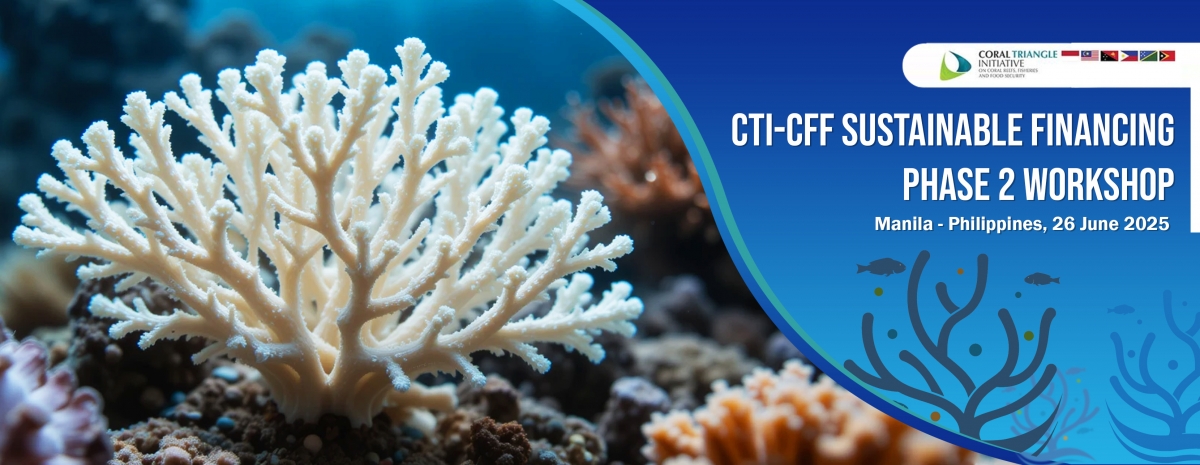
Building Financial Tools for Marine Protection: CTI-CFF Sustainable Financing Phase 2 Workshop
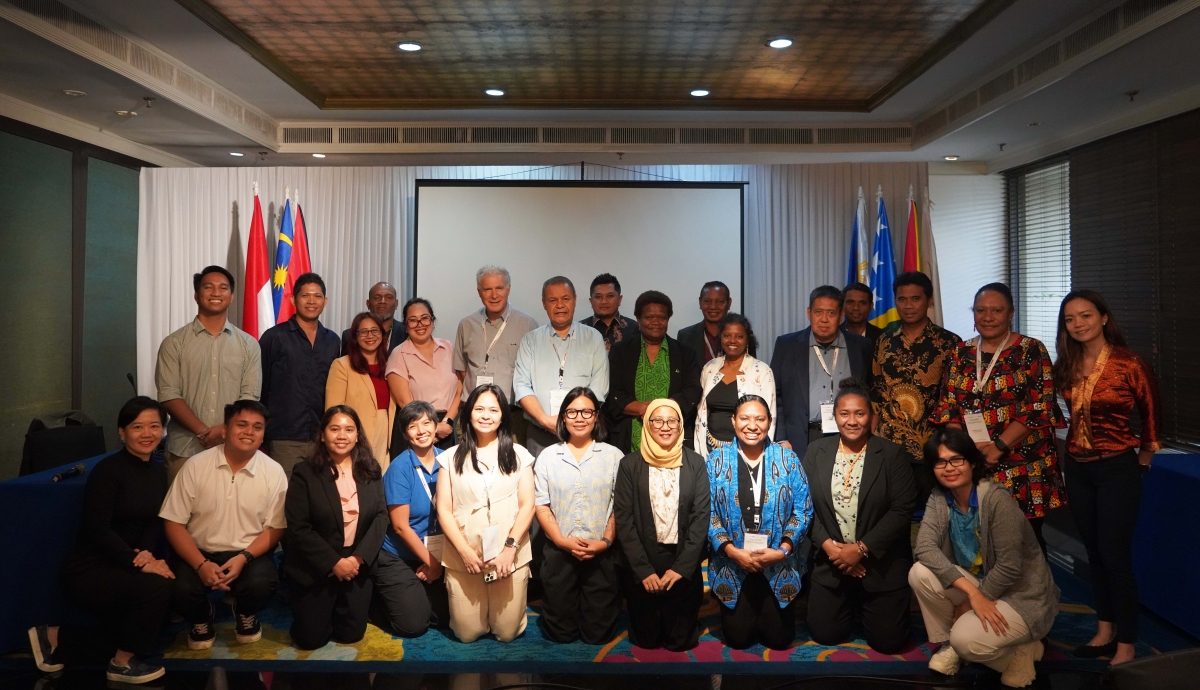
Manila, 26 June 2025 – As climate and economic pressures mount in one of the world’s most biodiverse marine regions, the Coral Triangle Initiative on Coral Reefs, Fisheries, and Food Security (CTI-CFF) convened the second phase of its regional workshop on sustainable financing. Held from 24–26 June 2025 in Manila, the event brought together government representatives, partners, and stakeholders from the CT6 member countries—Indonesia, Malaysia, Papua New Guinea, the Philippines, Solomon Islands, and Timor-Leste.
Building on the foundations of the first phase held in November 2024, the Phase 2 workshop deepened participants’ capacity to develop and implement conservation finance strategies tailored to national and regional needs. This knowledge exchange was designed to support the CT6 in identifying innovative financial mechanisms to support the Coral Triangle Conservation Fund (CTCF) and the implementation of the Regional Plan of Action (RPOA) 2.0.
A Timely and Transformational Training
The workshop featured in-depth sessions on Conservation Trust Funds (CTFs), blended finance, blue and green bonds, debt-for-nature swaps, biodiversity credits, and tourism revenue mechanisms. It also emphasised stakeholder engagement, private sector partnerships, and feasibility planning.
Sessions were led by Dr. David Meyers, Executive Director of the Conservation Finance Alliance.
“It’s been a pleasure to see participants learning from each other and sharing across CT6 countries. There is already so much that’s working—and even more opportunity to build on that. I hope governments and partners continue to recognise that financing the Coral Triangle is not a cost—it’s an investment in natural infrastructure, resilience, and the region’s future,” said Dr. Meyers.
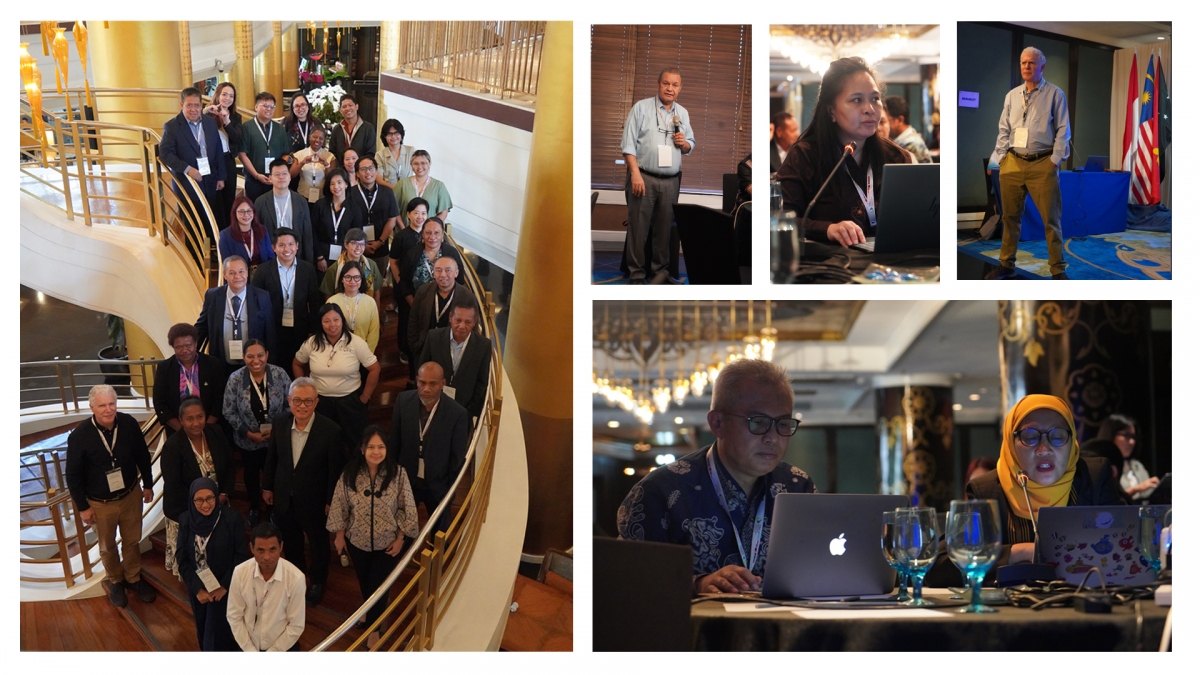
Participants from each CT6 country engaged in hands-on breakout sessions and shared experiences on their national financial landscapes, identifying opportunities to tailor global finance mechanisms to local contexts. The programme concluded with the development of country-specific roadmaps and initial planning for Phase 3 of the training.
One of the highlights of the workshop was the presentation of practical country-level experiences. Indonesia shared its ongoing efforts to develop innovative sustainable financing models, including the Coral Bond and the Debt Swap for Nature initiatives. These models aim to unlock large-scale investment in marine conservation by leveraging national and international financial instruments. In parallel, Rare presented its Impact Bond project, which is currently being implemented to support community-based conservation outcomes. Both Indonesia and Rare expressed their readiness to support any CT6 country that may wish to further explore or adapt these approaches within their national context.
From Awareness to Action
The workshop aligns with Output A1.2.1.a of the RPOA 2.0, which focuses on the feasibility of sustainable finance mechanisms such as payments for ecosystem services and environmental funds. By fostering regional collaboration and technical capacity, CTI-CFF continues to demonstrate leadership in scaling financial innovations for marine and coastal conservation.
“The future of marine conservation depends on more than passion—it depends on financial strategy,” said Dr. Frank Keith Griffin, Executive Director of the CTI-CFF Regional Secretariat. “We’re proud to see the region stepping up with new knowledge and partnerships to back our environmental commitments.”
Strengthening Regional Partnerships
The event was made possible with the support of strategic partners including the Wildlife Conservation Society (WCS), Blue Institute, and the Philippines Bureau of Fisheries and Aquatic Resources (BFAR). These collaborations underscore the importance of co-investment and co-learning in building sustainable financial systems for the Coral Triangle.
“It has been a valuable learning experience, not just in terms of understanding the evolving landscape of sustainable financing, but also in seeing how various countries and organisations are adapting these tools to support marine biodiversity and coastal livelihoods,” said Ms. Kathryn Cachapero, Senior Operations Manager, Wildlife Conservation Society - Philippines.
“Going forward, WCS looks forward to working closely with CTI-CFF and country partners to turn these ideas into action and to ensure that financing strategies remain inclusive, community-driven, and grounded in the ecological realities of the region.”
As the CTI-CFF continues to drive capacity development across the region, the workshop marks another important step in translating complex financing concepts into practical, impactful strategies. Phase 3 of the program will further support countries in assessing the feasibility of the proposed solutions and advancing toward long-term financial sustainability for marine conservation.
###
Note to media: Quotes included in this release are attributable to the individuals named and should not be attributed to the media contact listed below. For interview requests or further comment, please coordinate with the CTI-CFF Regional Secretariat.
About the Coral Triangle Initiative on Coral Reefs, Fisheries and Food Security (CTI-CFF)
The Coral Triangle Initiative on Coral Reefs, Fisheries and Food Security (CTI-CFF) is a multilateral partnership of six countries—Indonesia, Malaysia, Papua New Guinea, the Philippines, Solomon Islands, and Timor-Leste—working together to protect the Coral Triangle, the global epicenter of marine biodiversity. Often called the “Amazon of the Seas,” the Coral Triangle is home to 76% of the world’s known coral species (over 600 species of reef-building corals) and 37% of the world’s reef fish species, supporting the livelihoods and food security of more than 130 million people.
Through its Regional Plan of Action (RPOA 2.0), CTI-CFF drives regional collaboration to conserve coral reefs, expand marine protected areas, ensure sustainable fisheries, and build resilience to climate change. The CTI-CFF Regional Secretariat, based in Manado, Indonesia, coordinates this collective effort—bringing together governments, partners, and communities to advance a healthy, resilient, and inclusive blue economy across the Coral Triangle.
For more inquiries & information:
Fritzgerald Wenur, Marketing & Information Officer, CTI-CFF Regional Secretariat
E: fritzgerald.wenur@cticff.org // www.coraltriangleinitiative.org
Kimberly Chung, Communication & Information Manager, CTI-CFF Regional Secretariat
E: kimberly.chung@cticff.org // www.coraltriangleinitiative.org